Golden Teacher Mushroom Spores: Complete Microscopy & Beginner Guide
If you love looking at tiny wonders under a microscope, you have probably heard about golden teacher mushroom spores. Many hobbyists and science fans start their home lab journey with this famous strain. When I first set up my own desk microscope a few years ago, I felt nervous about picking the right sample to study. A friend told me to try golden teacher mushroom spores first, and it made learning so much easier.
These tiny fungal cells are easy to spot, clear to measure, and full of neat details. In this guide, we will walk through what makes them special, how to view them on a glass slide, and what to check before you look for golden teacher mushroom spores for sale. You do not need a fancy college degree to enjoy fungal science. Let us dive right in and explore this amazing microscopic world together!
What Are Golden Teacher Mushroom Spores?
Think of golden teacher mushroom spores as tiny biological seeds made by a famous fungus called Psilocybe cubensis. Each single cell is way too small for your bare eyes to see. You need a good compound microscope to spot them. When millions of these cells gather together, they look like dark purple-brown dust. Scientists and home hobbyists love studying them for taxonomy and fungal research.
Because they do not contain active psychedelic compounds, people can legally study them in many places. I always tell new lab fans that golden teacher mushroom spores act like a great textbook for beginners. They show classic traits that help you understand how other fungal strains look. Whether you use a liquid syringe or a dry foil print, these samples give you hours of fun discovery right at your desk.
Complete Golden Teacher Biography and Strain Table
Before you place a slide under your lens, it helps to know the full story of this classic variety. The strain first popped up in the 1980s, and most experts believe it came from Florida. It got its name from its pretty golden-yellow caps and the wisdom people linked to studying it. Over the decades, golden teacher mushroom spores became the gold standard for reference charts. Here is a complete biography table showing all the key facts and traits you need to know.
Why Beginners Love Studying These Spores
Starting a new science hobby can feel tricky if your tools or samples are hard to work with. That is why so many teachers recommend golden teacher mushroom spores for first-time slide makers. First, this strain drops huge amounts of spores. That means every sample is packed with plenty of cells to look at. You will not waste hours hunting around an empty glass slide.
Second, there are thousands of photos and guides online for this exact strain. When you look through your eyepiece, you can easily compare your view with trusted lab pictures. When I made my very first wet mount slide, having reference photos saved me from guessing what I was seeing. Studying golden teacher mushroom spores builds your confidence fast. Once you master focusing on these clear, oval cells, moving on to rarer fungal species feels like a breeze.
What Golden Teacher Mushroom Spores Look Like Under a Microscope
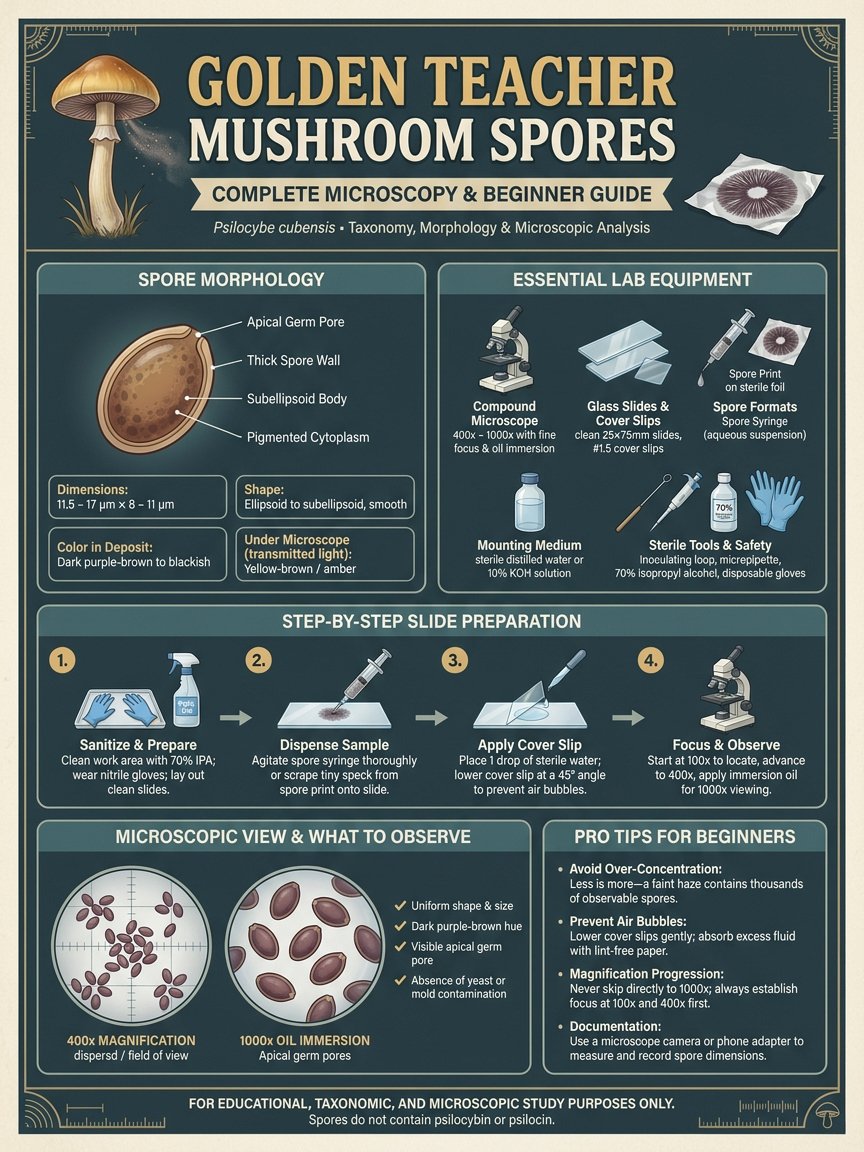
Looking at golden teacher mushroom spores through a good lens feels like looking at tiny gems. At low power, like 100x magnification, they look like tiny dark specks floating in water. Once you switch up to 400x magnification, the real magic starts to happen. You will see smooth, oval shapes with a rich purple-brown glow.
If your microscope has a 1000x oil immersion lens, you can spot even finer details. At this high zoom, you can clearly see the thick outer cell wall and a tiny opening at one end called a germ pore. Sometimes the golden teacher mushroom spores group together in loose clusters. Other times they float apart nicely across the glass. Taking notes and sketching these shapes in a lab notebook makes the whole process feel like real scientific discovery.
Different Ways to Collect and Study Samples
When you browse golden teacher mushroom spores for sale, you will notice they come in three main forms. Each format fits a different style of microscopy work. Here is how they work:
- Spore Syringes: These plastic tubes hold sterile water mixed with millions of suspended cells. They are super easy to use because you just squeeze one tiny drop onto your glass slide.
- Spore Prints: A print looks like a dark wheel stamped onto clean aluminum foil or heavy paper. You scrape a tiny bit of dust off the foil into a drop of clean water to view it.
- Spore Swabs: Labs collect cells onto sterile cotton or nylon tips. Swabs take up almost no space and work great for dry storage.
Personally, I prefer syringes when working with golden teacher mushroom spores because they keep things neat and fast for quick weekday study sessions.
Step-by-Step Guide to Preparing a Microscope Slide
Making a clean slide does not take long, as long as you follow a neat routine. Before you touch your golden teacher mushroom spores, wipe down your desk and glass slides with isopropyl alcohol. Dust and lint can ruin your view and look like fake structures under high zoom. Next, pick up your spore syringe and shake it well for about thirty seconds. Because spores sink to the bottom over time, shaking spreads them evenly through the water.
Place just one small drop of liquid right in the middle of your clean glass slide. Hold a thin glass cover slip at a 45-degree angle and gently lower it onto the drop. Lowering it slowly pushes air bubbles out to the sides. Wait two minutes so the liquid settles flat. Now your golden teacher mushroom spores are ready for the microscope stage!
How to Spot High-Quality Samples and Avoid Contamination
Nothing is more frustrating than looking through your lens and seeing fuzzy mold instead of clean fungal cells. When checking golden teacher mushroom spores, clarity is your best friend. In a good liquid syringe, the water should look crystal clear with tiny dark flecks floating inside. If the water looks cloudy, slimy, or yellow, bacteria might be growing inside the tube.
When you place golden teacher mushroom spores under your lens, look for uniform oval shapes. Every cell should be roughly the same size and color. If you see weird strings, fast-moving dots, or green patches, your sample is likely contaminated. Reputable labs work inside clean flow hoods to keep unwanted germs out. Always check your slides carefully and keep good records of what you see. Clean habits protect your microscope lenses and make your taxonomy notes accurate.
Where to Buy Golden Teacher Mushroom Spores Safely
Finding a trustworthy shop online takes a little bit of smart homework. Before you decide to buy golden teacher mushroom spores, look closely at the seller’s website and reputation. Trusted vendors always state clearly that their products are for microscopy and taxonomy research only. Stay away from sketchy sites that make wild health claims or offer illegal growing advice.
Check customer reviews to see if other hobbyists received clean, viable samples. A great shop will pack your golden teacher mushroom spores in sterile, sealed tubes with clear labels. They should also offer helpful customer support if a package gets damaged in the mail. When I look for golden teacher mushroom spores for sale, I always pick companies that share real microscope photos of their own stock. That transparency proves they actually test their samples in a real lab.
Best Ways to Store Your Spores for Long-Term Study
Once you buy golden teacher mushroom spores, storing them the right way keeps them fresh for many months. Heat and bright sunlight are the biggest enemies of delicate fungal samples. If you leave a syringe on a sunny windowsill, the cells can break down and lose their natural shape. Instead, put your syringes inside a clean zip-top bag and place them in your refrigerator.
Keep the fridge temperature between 35°F and 46°F for the best results. Never put golden teacher mushroom spores in the freezer, because ice crystals will crush the tiny cell walls. If you own foil spore prints instead of liquid tubes, store them inside an airtight envelope in a cool, dark drawer. Kept cool and dry, foil prints can stay good for several years. Good storage saves you money and keeps your home lab ready anytime.
Legal Rules and Ethics You Should Know
Being a responsible science fan means knowing and following the laws in your area. In most places, golden teacher mushroom spores are completely legal to own, trade, and study under a microscope. Why? Because the spores themselves do not contain psilocybin or any banned chemicals. However, rules can change depending on where you live.
For example, in the United States, states like California, Idaho, and Georgia have strict bans against bringing these spores across their borders. Trusted vendors will not ship golden teacher mushroom spores to restricted locations. Also, remember that germinating or growing these spores into mushrooms is illegal in many countries. Always keep your hobby strictly focused on slide observation, photography, and taxonomy. Respecting local laws keeps the microscopy community safe and open for everyone.
Golden Teacher vs. Other Popular Strains
Curious how this classic variety stacks up against other famous microscopy samples? Let us compare golden teacher mushroom spores with two other well-known strains: B+ and Penis Envy. All three belong to the same species, so their spores share a similar purple-brown color and oval shape. However, collecting and viewing them feels quite different.
Penis Envy caps often stay tight and closed, which means they drop very few spores. Because of that, slides from that strain can look sparse, and swabs are usually required. On the other hand, B+ drops plenty of spores, just like Golden Teacher, making both great for syringes. Still, golden teacher mushroom spores win first place for beginners because they have the largest library of reference data online. Starting here gives you a rock-solid baseline before you explore rarer varieties.
Conclusion
Exploring the hidden world of golden teacher mushroom spores is one of the most rewarding ways to start a home microscopy hobby. With their clear oval shapes, rich purple-brown color, and generous spore counts, these tiny cells make every slide session exciting. Always remember to keep your workspace clean, store your tubes in a cool fridge, and check your local laws before you buy golden teacher mushroom spores. Grab your microscope, prepare a fresh glass slide, and see what amazing details you can discover today! Have you ever looked at fungal spores under a lens before? Share your favorite microscopy tips or questions in the comments below!
Frequently Asked Questions (FAQs)
1. Can I see golden teacher mushroom spores without a microscope?
No, you cannot see a single spore with just your eyes. Each cell measures only about 11 to 17 micrometers long. You can only see them with your naked eye when millions clump together as a dark print or dark specks inside a syringe.
2. How long do golden teacher mushroom spores last in the fridge?
When stored properly inside a clean, dark refrigerator between 35°F and 46°F, liquid spore syringes easily last from 9 to 24 months. Dry foil spore prints kept in a cool, dark drawer can stay stable for several years.
3. What magnification do I need to study these spores?
You should start at 100x magnification to find where the spore clusters sit on your slide. Then switch to 400x to see their smooth oval shape and purple-brown color. A 1000x oil immersion lens lets you inspect the tiny germ pore.
4. Why do some spore syringes look completely clear?
Because individual spores are microscopic, a syringe can hold millions of them and still look mostly clear. Always shake your syringe hard for 30 seconds before making a slide so any settled clusters mix back into the liquid.
5. Are golden teacher mushroom spores legal to buy online?
In most countries and most U.S. states, yes, they are legal for microscopy and taxonomy research because they hold zero active psychedelic compounds. However, local laws vary, and places like California, Idaho, and Georgia restrict them.
6. Should I buy a spore syringe or a spore print?
If you are new to microscopy, buy a spore syringe. Syringes come pre-mixed in sterile water, so you simply place one drop on a slide. Spore prints take extra steps to scrape and hydrate, though they store well long-term.